Read This If You Are Under 40 and Your Joints Are Quietly Ruining Your Daily Life
Too Young to Hurt This Much: The 21-Day Joint Pain Protocol a Nigerian Medical Doctor Built After She Could No Longer Climb Her Own Stairs at 24.
You woke up this morning and the first thing you did — before you even sat up properly — was test your joints.
You did not think about it consciously. Your body just did it. That slow shift in bed to see how things feel today. That quiet internal assessment that happens every morning before you have even opened your eyes fully.
How bad is it today?
If it is a good morning, you climb out of bed normally, walk to the bathroom, and try to forget about it. You have a job to get to. A life to live. You do not have time for this.
But you know — and this is the part nobody around you seems to understand — that your day has already started with a negotiation between you and your own body.
Some days you lose that negotiation before 7 AM.
Maybe it is the stairs at work. You have started taking the lift even when it is quicker to walk up two flights. Not because you are lazy. Because by midday, your knees or ankles will already be aching and you do not want to start the day already in debt.
Maybe it is the long commute — sitting in a bus or tricycle for an hour and then standing up immediately, feeling that stiffness in your joints that nobody your age is supposed to feel.
Maybe you have stopped mentioning it to people because you are tired of the look they give you.
"But you are so young... are you sure it is not just tiredness?"
You know it is not tiredness. You know the difference. You have known for a while now.
Maybe you have quietly started calculating venues before you agree to attend events. Does this place have a lift? How many stairs? How far is the walk from the park? How long will I be standing?
You are twenty-something years old. And you are doing calculations that are supposed to belong to someone thirty years older.
Maybe you have spent money on Deep Heat spray, Diclofenac tablets, a physiotherapy session that cost you what felt like a week's groceries. Maybe you have tried resting it, drinking more water, eating better. Maybe you have been told by a very busy doctor to "just rest and take painkillers."
And maybe you walked out of that consultation feeling more confused than when you walked in.
I know this experience. Not because I read about it somewhere. Not because a patient described it to me.
Because I lived it. At 24 years old. As a practicing medical doctor. Standing at the bottom of a staircase at 7 AM, wondering what was wrong with my own body.
Drop everything you are doing now and listen to every word I am about to say.
"Because I am about to share with you a simple 21-day system that changed everything for me — and for hundreds of young adults across Nigeria, Ghana, Kenya, Cameroon, the UK, and Canada who were exactly where you are right now."
Our grandmothers swore by it.
Long before there were physiotherapy clinics and anti-inflammatory tablets and pharmacy shelves lined with things that help for four hours and then stop... there was knowledge. Passed down through kitchens and market visits and the quiet authority of older women who had watched generations of bodies heal.
They called it ORI. We know it as shea butter. And while we spent decades dismissing it as "old-fashioned," peer-reviewed medical journals were quietly publishing papers on the anti-inflammatory properties of its active compounds — the exact same compounds our grandmothers had been applying correctly, by feel, for generations before anyone named them in a laboratory.
I am not sharing this to romanticise the past. I am sharing it because it took me becoming a medical doctor — and reading the research at 1:30 in the morning on a hospital night shift — to finally respect what my family had always known.
My name is Dr. Valerie Okorie.
First thing you should know about me: I am not a wellness influencer. I am not a health coach. I have a medical degree, a hospital practice, and — at 24 years old — joint pain that was quietly ruining my daily life.
I am a doctor who could not climb a flight of stairs without her knees screaming. Who spent six months trying everything the pharmacy and the internet suggested. Who finally found the real answer not in a clinical guideline — but in a combination of medical research, a late-night literature review, and the very thing my godmother had been telling me to use from the beginning.
I built a 21-day protocol from everything I discovered. Tested it on myself. Then on five colleagues. Then on hundreds of young adults across Nigeria and beyond who were experiencing the same quiet, embarrassing, daily pain — whether they were male or female, healthcare worker or desk professional, Lagos resident or diaspora Nigerian living in London.
And I packaged everything into one simple, affordable guide that you can start using today.

Dr. Valerie Okorie — Medical Doctor & Health Educator
Here is exactly what happened to me — and why it led to this protocol.
It was a Saturday night in November.
I had just turned 24 the week before, and my friends had insisted on throwing me a proper birthday celebration. Music, food, dancing — the full thing. I remember getting home around 2 AM, still laughing, still buzzing from the night.
I kicked off my shoes at the door. Walked to the staircase in my building.
And then I stopped.
My right knee was throbbing. Not dramatically. Just... there. Like a dull knock from inside the joint. I assumed it was the shoes. Wrote it off. Went to bed.
But it did not go away.
Three weeks later, I was on a 12-hour hospital shift. By hour eight, I was limping — not dramatically, just enough that I noticed it. Just enough that I had to slow down walking between wards.
You are just tired, I told myself. This is nothing.
But it kept coming back. Every morning, that first moment getting out of bed felt like my knees had been packed with sand overnight. I would stand in the bathroom waiting for them to loosen before I could walk properly.
Every flight of stairs became a private calculation. Every long shift a debt I would pay later in aching joints. Every morning a negotiation.
I was twenty-four years old. A practicing medical doctor. And I was quietly afraid of staircases.
The morning that finally broke me.
It was a Tuesday. Just finished a night shift. My ankles were tight, my knees were aching, and all I wanted was to get home and sleep.
I stood at the bottom of my staircase. Four flights. I had climbed them a thousand times without thinking.
But that morning, I looked at those stairs and I felt... small.
What is wrong with me?
I had spent the night explaining anatomy to a junior colleague. And I was standing at the bottom of my own staircase at 7 AM, genuinely unsure if my body would carry me to the top.
I sat down on the second step.
And I cried.
Not for long. Just enough. Then I wiped my face, climbed slowly to my flat, and promised myself I would figure this out.
My godmother's advice — the thing I should have listened to immediately.
The first person I told was my godmother.
She is one of those women who has a warm, direct answer for everything — answers that come from sixty years of watching life happen to people. She listened carefully as I described the knee and ankle pain.
"Nne," she said, "what do you expect? You are eating fire and wondering why your body is burning. Go and get ORI. Apply it to the joints every night. Eat properly. Your body is trying to talk to you and you are too busy to listen."
I smiled and thanked her.
And then — because I had a medical degree and an ego about it — I completely ignored her.
ORI? I had pharmacology textbooks. I knew about anti-inflammatory mechanisms. I did not need ancestral remedies.
So I tried everything the pharmacy and the internet suggested. Here is what happened.
First, I tried Deep Heat spray.
Three times a day, both knees. The warmth felt comforting. The relief lasted about four hours. By hour five, the ache was back — sometimes worse than before. I bought four bottles over six weeks. I realised I was not treating anything. I was just turning the pain's volume down temporarily. Then it came back louder.
Then I tried Diclofenac and Felvin tablets.
Anti-inflammatory. A clinically reasonable approach. The pain reduced, yes. But after two weeks I caught myself needing them to function comfortably through a shift. I stopped abruptly. I am a doctor. I know what long-term NSAID dependency looks like. I was not going to be that person at twenty-four.
Then I tried complete rest.
Three full days off. Feet up. Minimal movement. The pain improved noticeably. I genuinely thought I had solved it. I went back to work on day four. By the end of that shift, the ache had returned — exactly as it was before. Three days of rest had bought me eight hours of relief. That was not a solution. That was a pause button.
Then I tried physiotherapy.
One session. A printed sheet of eight exercises. Instructions to do them twice daily. I looked at that sheet for two weeks without completing a single session — not because I was lazy, but because the exercises were designed for someone with a different body, a different schedule, and a different life to mine. Generic. Western. Not built for a Nigerian doctor working twelve-hour shifts.
Then I tried "just eating better."
More water. Less processed food. Three weeks of real effort. My skin improved. My energy improved. My joints? Unchanged. I was treating the wrong problem.
Then I told myself it was stress.
This was the most dangerous thing I did — because it gave me permission to stop looking for the real answer. When things calm down, it will pass. Things never calmed down. The pain never passed.
The night everything changed — and where the real answer came from.
It was another overnight hospital shift. That quiet hour between 1 AM and 2 AM when the ward is still.
I opened my laptop. And for the first time, I typed the honest question I had been avoiding for months:
Joint pain in young adults — root cause. Not treatment. Root cause.
I read for three hours.
Clinical papers. Journal articles. A musculoskeletal textbook chapter I had never thought to apply to my own body. Inflammatory pathway research. Postural biomechanics in occupational workers. Dietary inflammation markers in adults under thirty-five.
And I found them.
Three specific, modifiable, fixable patterns. Present in the lives of almost every young adult I had been describing to myself as "just unlucky with their joints." Patterns in the way we eat, the way we sit, stand, and move in Nigerian work environments — that were silently, daily, driving joint deterioration from the inside.
This cannot be the whole answer, I thought. It is too simple.
I called a former lecturer whose specialty is musculoskeletal medicine. It was 4 AM. He picked up anyway.
"Yes," he confirmed without hesitation. "In young adults with physically demanding or sedentary occupations — this pattern is almost always the same. It is rarely structural. It is almost always modifiable."
I put down the phone.
And I thought of my godmother. Her exact words.
"Go and get ORI."
She had been pointing at the same root cause for months — in the language she knew. I had been refusing to listen because it was not in a textbook. So I opened the textbooks and looked for it properly. The anti-inflammatory properties of shea butter — specifically beta-amyrin and lupeol found in Vitellaria paradoxa — had been documented in peer-reviewed literature for decades. It was not folk medicine. It was biochemistry that my culture had been applying correctly, by feel, long before anyone published a paper about it.
I sat in that quiet ward and felt two things simultaneously: embarrassed, and genuinely excited.
I designed the protocol over the next two weeks. I tested it on myself first.
Not as a product. Not to sell. Just to see if it would work on the body that had been failing me for six months.
Phase 1: five days to understand exactly what was happening in my joints. Not guessing. Not Googling in fear. Understanding.
Phase 2: thirteen days of specific daily actions — a morning joint activation routine done in under 7 minutes, Nigerian anti-inflammatory food swaps using ingredients from any local market, the upgraded shea butter recipe using two additional ingredients that research confirmed amplified its anti-inflammatory effect, and posture corrections built specifically around the ways young Nigerians sit, commute, stand, and work.
Phase 3: a permanent maintenance system that would keep the results without requiring daily effort forever.
The first five days: no dramatic changes. I kept going. I had read enough about biological timelines to know that real healing is not instant.
Day 6. The morning everything was different.
I woke up at 6 AM for an early shift.
Sat up in bed. Put my feet on the floor.
And walked to the bathroom.
Without thinking.
No internal check. No morning stiffness. No sand-in-the-joint sensation. No calculation.
I stopped in the bathroom doorway.
Walked back to the bed. Sat on the edge. Got up again.
Nothing. No pain whatsoever.
I stood there for a long moment. Then I sat on the floor, right there in my bedroom, and cried. Not like that Tuesday morning at the bottom of the staircase. The other kind of crying.
By Day 14, a colleague noticed the change.
I was walking quickly between wards — the way I used to walk, before the pain made me slow — when Dr. Amaka stopped me in the corridor.
"Dr. Valerie. You look different today. Are you okay? You are moving differently."
"I am fine," I told her. "Better than fine, actually."
"What changed?"
I smiled. "I finally listened to my godmother."
By Day 21, I had climbed my four flights of stairs without stopping, without slowing, without thinking about it at all.
The staircase that had made me cry on a Tuesday morning in November? I had stopped counting the steps.
I shared it with five colleagues. Then it began to spread.
Dr. Yemi, 29, orthopaedic rotation — knee pain from years of standing in surgical theatres. He reported significant improvement by Day 8 and sent me a voice note at midnight to say so.
Nurse Kemi, 27, surgical ward — ankle swelling and pain from 12-hour shifts. By Day 10, she told me she had worn heels to church for the first time in eight months. She was emotional when she said it.
Emeka, 31, junior doctor — desk-related knee pain from long hours in hospital chairs. He called me on Day 11 to say he had gone for a run — his first in two years — without any discomfort at all.
Three different people. Three different pain patterns. Three different bodies. The same 21-day protocol. The same result.
That was the moment I decided to write it all down properly — in plain language, in a format anyone could follow, designed around the Nigerian body and the Nigerian life. For every young adult who has been quietly suffering the same way I was. Male or female. Healthcare worker or office professional. Lagos or London. Abuja or Accra.
Word spread. My phone was never quiet. People I had never met were messaging me — nurses, pharmacists, teachers, engineers, accountants, young professionals in physically demanding jobs and desk jobs alike. All experiencing the same pain. All having tried the same things. All getting the same non-answers.
I was spending hours every week explaining the protocol individually. So I made a decision.
I put everything — the full 21-day system, the ingredient lists, the exact daily steps, the timing, what to avoid, how to know it is working, when to stop and see a doctor in person, and the complete maintenance protocol — inside one simple, clear, affordable guide.
Every piece of medical knowledge. Every ancestral remedy validated by research. Every practical tool designed specifically for the Nigerian body and lifestyle. In one place. For a price less than a single physiotherapy session.
Introducing...
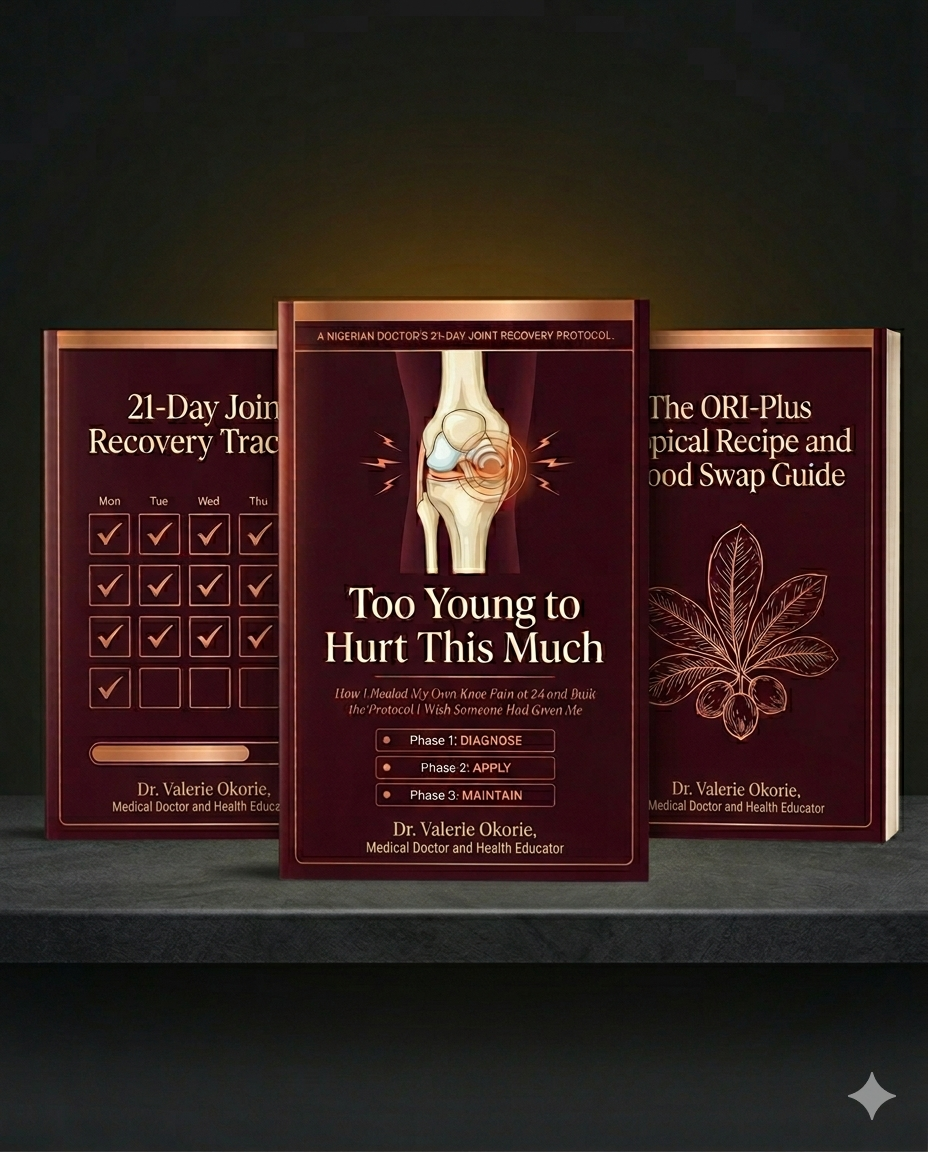
Too Young to Hurt This Much
A Nigerian Doctor's 21-Day Joint Pain Recovery Protocol
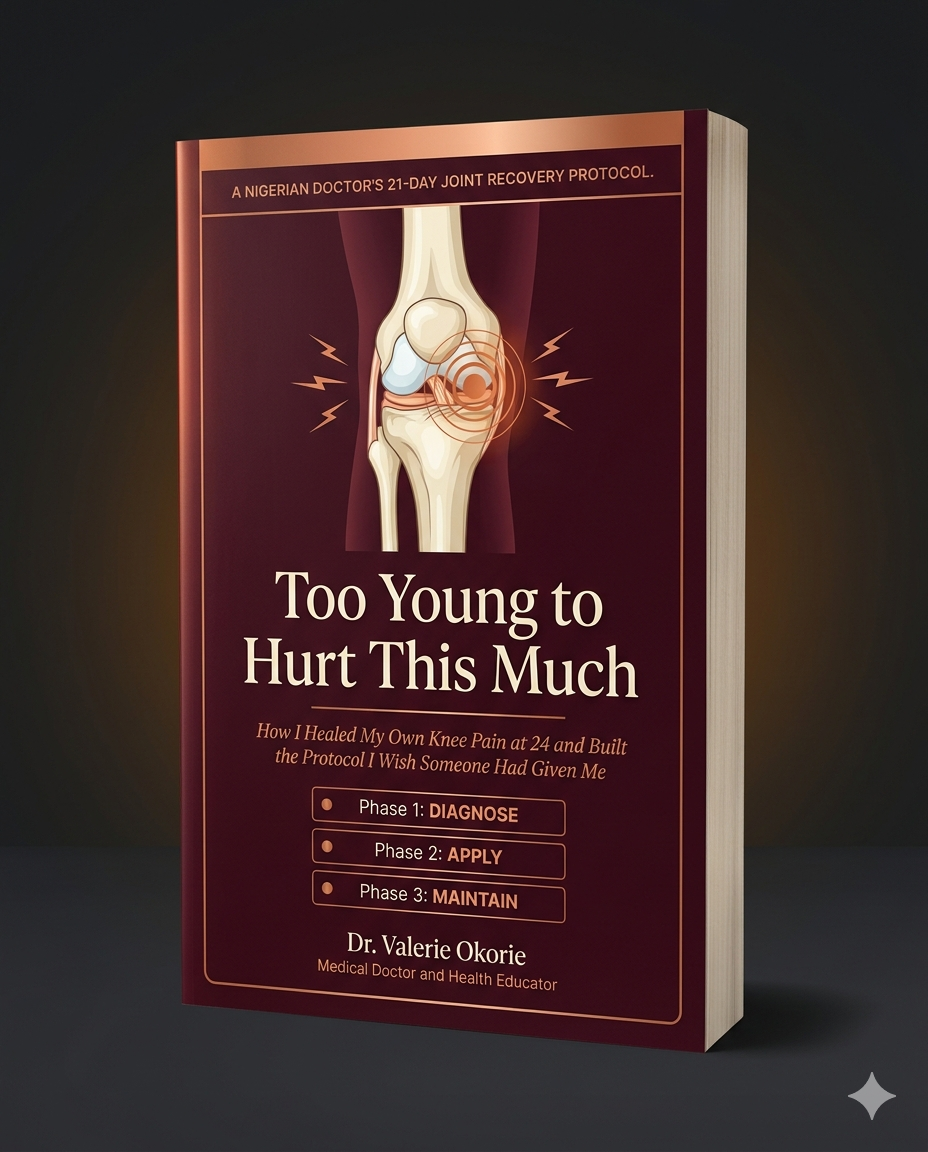
Inside this guide, you will discover:
- The 3-Minute Joint Type Self-Test — Pg. 4. Before Day 1 even begins, this self-test tells you exactly which type of joint issue you are dealing with — inflammatory, mechanical, or postural. Your entire protocol is then focused on your specific result. Most people have been treating the wrong type for months.
- The Three Hidden Root Causes — Pg. 8. Not age. Not weight. Not "just stress." The three specific, daily, modifiable triggers silently driving joint pain in young Nigerian adults — in the way you eat, the way you sit, and the way you move in a Nigerian work environment. Once you see them, you cannot unsee them.
- The Complete 21-Day Daily Action Stack — Pg. 16. Your full day-by-day recovery guide. Morning joint activation movements in under 7 minutes. Nigerian anti-inflammatory food swaps using ingredients from your local market. Posture corrections for hospital shifts, office chairs, long commutes, and market standing. Every day is specific. Every action is achievable for someone with a demanding life.
- The ORI-Plus Topical Protocol — Pg. 31. The medical upgrade of your grandmother's shea butter. A precise recipe combining ORI with two additional accessible ingredients that research confirms significantly amplify its anti-inflammatory effect on joints. Make it in your kitchen in under 5 minutes. Apply it correctly from Day 1.
- The Permanent Maintenance System — Pg. 42. What to do after Day 21 to make sure the pain never comes back. Includes a monthly self-assessment, cycle-aware inflammation management for women, and the long-term lifestyle habits that protect your joints for decades. Not a daily chore — a ten-minute-per-week investment that lasts a lifetime.
- The Joint Pain Red Flag Guide — Pg. 48. A medically accurate one-page reference that tells you clearly and honestly when to stop self-treating and see a doctor immediately. Your safety is built into this guide. Know the difference between what this protocol can fix and what requires a clinical consultation in person.
💬 Real People. Real Results. Real Stories.
★★★★★
Aunty Valerie! I been dey use Deep Heat every single day for 8 months. My bag never go anywhere without that spray — e don become part of my uniform. After just Day 9 of this protocol, I did not even remember to put it in my bag before leaving the house. I forgot I needed it. That moment right there is when I knew this thing was different. The food swap list is something else — every ingredient is available at our local market. Nothing you need to order online or pay extra for. 5 stars and I will not reduce it.
★★★★★
As a man, I was embarrassed to admit my knees were giving me problems at 31. I blamed my gym routine. I blamed my weight. I was wrong about both. This protocol identified the real problem within the first 5 days — Phase 1 was genuinely eye-opening. The Posture Audit section alone was worth the price of the entire guide. I sit at a desk for 10 hours a day and had no idea what it was doing to my joints. By Day 12 I was back to training. Didn't even need the full 21 days to feel the difference.
★★★★★
I live in London and have access to every kind of physiotherapy and supplement you can imagine. None of it worked the way this 21-day protocol worked. What made the difference is that this was designed for MY lifestyle — the long shifts, the specific eating habits that drive inflammation, the posture corrections. Not generic Western advice designed for a 55-year-old. Five stars. I have already sent the link to three colleagues at my hospital. If you are in healthcare and experiencing joint pain, this was written for you.
★★★★★
Charley I fit tell you this thing work ooo. I get knee pain wey dey disturb me since 2023. I try everything from the pharmacy — nothing touched am. After Phase 2 I start to notice say something dey change. The morning stiffness wey I think was just normal for me start to disappear. By Day 14 I play 5-a-side football with my guys for the first time in one full year. Dr. Valerie, God bless you. 🙏 This protocol should be in every African household.
★★★★★
The ORI-Plus recipe card alone is worth triple the price. My mother has been putting shea butter on everything since I was a child and I never fully understood why it worked. Reading the science explanation in this guide — understanding the actual biochemistry — was one of the most satisfying moments I have had as someone with a pharmacy background. I have made three batches of the ORI-Plus recipe already. My ankle pain is 80% resolved and I am in Phase 3 maintenance now.
💬 Share Your Own Experience
Just So You Know... Putting This Guide Together Cost Me Over ₦62,456.
I want to be transparent about what went into this. I did not sit down one weekend and type it out.
- Months of personal medical research and access to peer-reviewed clinical journals — ₦18,000 in access fees
- Professional medical editor to review every claim and protocol step for accuracy — ₦12,000
- Testing the protocol with five colleagues over three months, tracking and documenting results — ₦8,456 in ingredients and monitoring tools
- Professional PDF design and layout formatting to make it clear and usable on any phone — ₦14,000
- Website hosting, secure payment setup, and launch costs — ₦10,000
Total invested: ₦62,456. Before a single copy was sold.
So I could charge ₦62,456 and justify every naira of it.
I am not going to do that.
Not even half that. Not ₦31,000.
Not ₦25,000.
Not even ₦19,000 — which is what the people I have shared this with told me it was worth.
A fair price for this guide would be:
₦19,000But today — for the first 50 buyers only — you get the complete guide for just:
₦9,800That is less than one physiotherapy session. For a complete 21-day system you keep for life.
Instant digital download. Readable on any phone, tablet, or laptop. Secure checkout via Selar.
⚡ WAIT! I Have a FREE Gift For You...
If you are among the first 50 buyers, you get these two bonuses included alongside your guide. Today only.
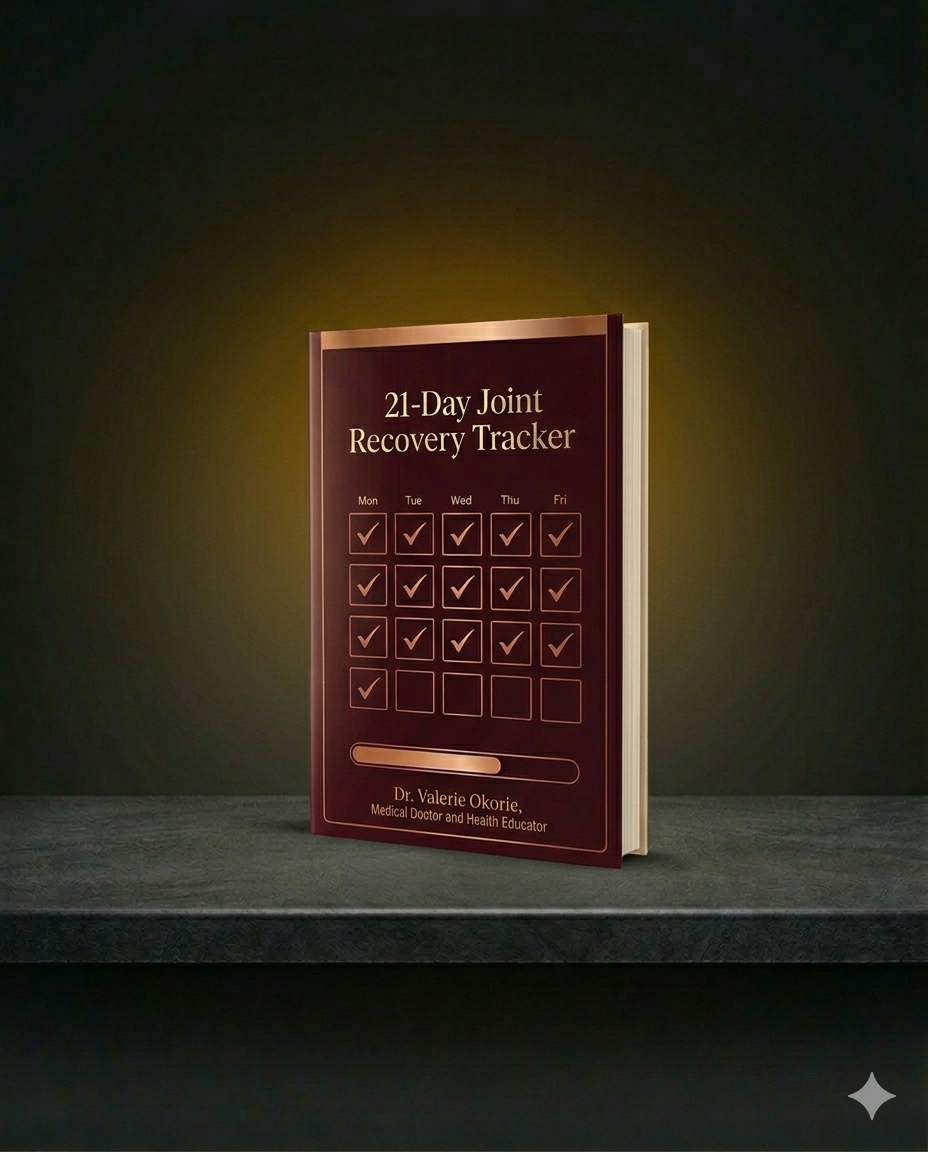
The 21-Day Joint Recovery Tracker
A printable daily checklist showing your progress building day by day. Seeing your own consistency laid out visually is one of the most powerful motivators to keep going all the way to Day 21 — and beyond. Value: ₦3,500. Yours FREE.
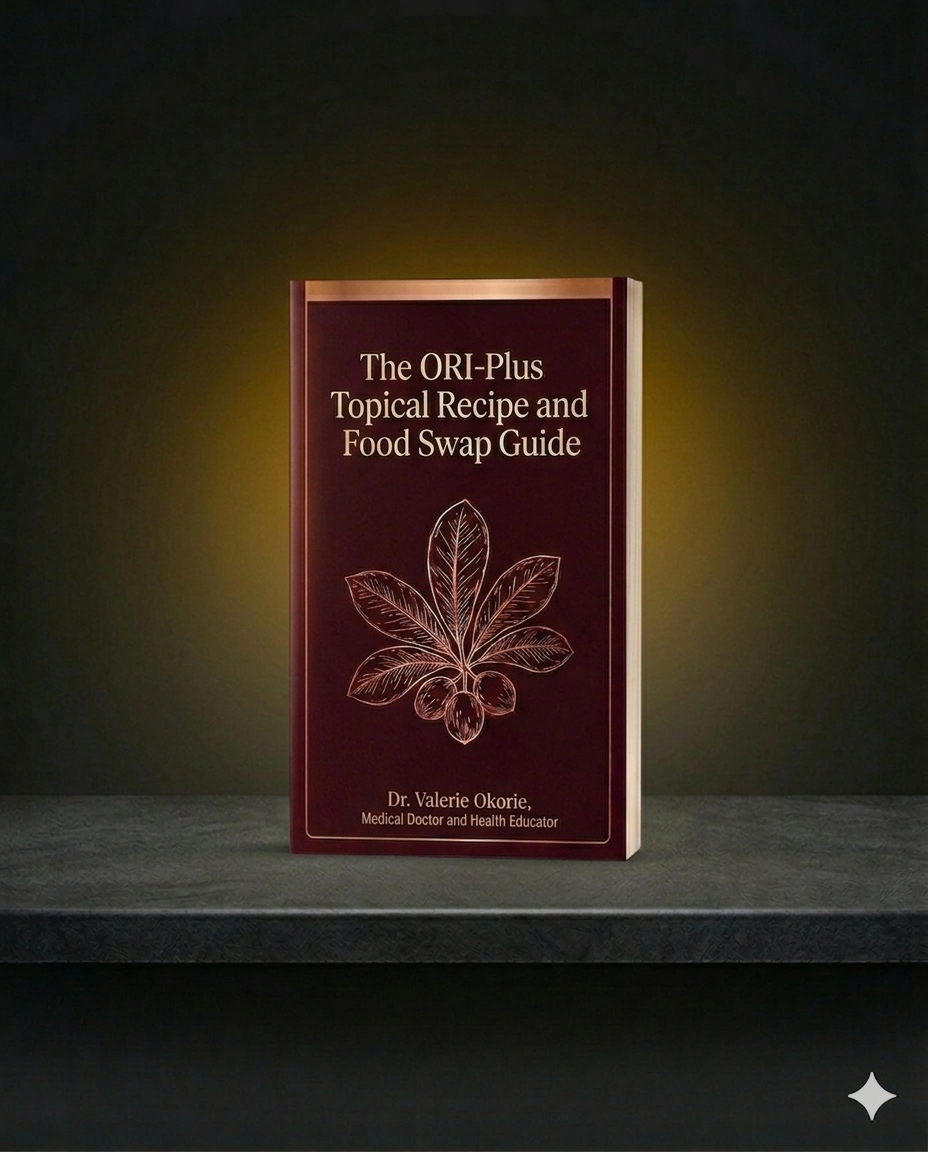
The ORI-Plus Topical Recipe & Nigerian Food Swap Guide
The complete standalone recipe guide for making your ORI-Plus anti-inflammatory topical at home — plus the full Nigerian Food Swap List in a clear, printable two-column table. Every ingredient available at any Nigerian market. No imports. No special orders. Value: ₦3,500. Yours FREE.
Combined value of both bonuses:
₦7,000
Included FREE with your order today
People Are Already Getting Their Copies...
Here is what our community looked like in the last 24 hours:
Too Young to Hurt — Buyers 🔒
47 members · Dr. Val's Community
Emeka O. 🇳🇬
Just paid! ₦9,800 for this is genuinely nothing compared to what I've wasted on sprays 😅 PAID
9:14 AM
Amara N. 🇳🇬
Payment completed! Bank transfer done. Finally something made for us young Nigerians. PAID
9:31 AM
Kwame A. 🇬🇭
Done from Accra! Mobile money sent. The posture checklist alone is going to help me — I sit at a desk all day 😅 PAID
9:47 AM
Fatima H. 🇳🇬
Just purchased! 🙏 I've had ankle pain for 7 months. Day 1 starts tomorrow morning. PAID
10:02 AM
Tunde B. 🇳🇬
Paid! As a footballer I was too proud to admit my knees hurt at 29. Happy I got over it and bought this. PAID
10:18 AM
Ngozi E. 🇳🇬
Done and done! 🔥 Download was instant through Selar. Already reading Phase 1. PAID
10:35 AM
David O. 🇰🇪
Payment successful from Nairobi! Been following Dr. Val for months. Finally made the decision. No regrets. PAID
10:52 AM
Thank you all so much — this means everything to me. 🙏 Just a reminder: only 3 spots left at the ₦9,800 price. Once they go, it returns to ₦19,000. Start your protocol today! — Dr. Val
11:05 AM ✓✓
Bear in mind — you are not the only one viewing this page right now.
Once those 3 spots are gone, the price returns to ₦19,000.
⏰ Claim My Spot Before It's Gone — ₦9,800Still Feeling Unsure? I Completely Understand.
Which is why I am making you a bold, completely risk-free promise:
Follow the 21-Day Protocol exactly as written. If you do not experience a meaningful, noticeable reduction in your joint pain by Day 21 — I will refund every naira. No questions asked. No awkward emails. No conditions.
You have a full 30 days from your purchase date to try the protocol and request a refund if it does not work for you. You can go through all 21 days, see the results for yourself, and still have 9 days to decide. The risk is entirely mine — not yours.
I can offer this guarantee because I have seen what this protocol does. But you should not have to take my word for it. Try it. See for yourself.
✅ I'll Try It Risk-Free — Get My Copy for ₦9,800💬 More Stories From People Who Started the Protocol
★★★★★
I work as a pharmacist and I have quietly begun recommending this guide to customers who ask about joint pain medication. The Red Flag Guide section is clinically accurate — it is exactly the information a patient should have to know when to self-treat versus when to walk into a clinic. As for my own knee pain — resolved by Day 16. I have five years of pharmaceutical training and Dr. Valerie's protocol is correct on every point I cross-referenced.
★★★★★
Joint pain in nursing is an occupational hazard nobody talks about honestly. My senior colleagues told me "you will get used to it." I refused to accept that. This protocol showed me I was right to refuse. Day 8 was my breakthrough day — I noticed I had completed a full shift without the usual ankle swelling. I am writing this on Day 21. Pain is gone. I am in the maintenance phase now, and it genuinely takes less than 10 minutes a week to sustain.
★★★★★
I bought this from Toronto because the description was too accurate to ignore. Desk job, long hours, Nigerian eating habits even while abroad, and knee pain my Canadian GP called "just from sitting." What surprised me is that even in a Canadian context, the food swaps are completely manageable — I found most ingredients at the African grocery store. The protocol itself is medically sound. I showed it to my GP here and she was genuinely impressed with how it was structured.
★★★★★
I cried on Day 10. Not from pain — from relief. I walked up the stairs in my church for the first time in seven months without holding the railing, without slowing down, without anyone noticing me hesitate. If you are sitting on the fence about this guide right now — stop sitting on it. Buy it. Follow it exactly as written. I promise you it will work.
★★★★★
J'ai acheté ce guide et j'ai été vraiment surpris par la qualité. I have had knee pain for 2 years. The doctors here told me there was nothing to do but rest. The 21-day protocol is very clear — I found all the ingredients at the central market in Douala without any problem. By Day 12 my pain was 70% reduced. By Day 19 I was walking normally again. Dr. Valerie, merci beaucoup. You helped me when I had already stopped believing anything would work.
Before You Leave This Page...
You have two choices right now. Both are honest. Choose the one you can live with.
✅ Option 1 — Take Action Today
Get Too Young to Hurt This Much right now. Follow the 21-day protocol exactly as written. Wake up on Day 6 and feel the difference. Climb your stairs, complete your shifts, play your sport, live your life — without calculating every movement in advance. Regain the body you had before this pain quietly took over your daily decisions.
✗ Option 2 — Close This Page
Go back to the Deep Heat spray. The painkillers. The physiotherapy sheet you never quite find time to do. The daily negotiation with your joints every time you approach a staircase or a long shift. Keep accepting pain that you do not have to accept — at an age when your body should feel invincible. Maybe things will somehow improve on their own. Maybe they won't. You already know which one is more likely.
Maybe you were meant to find this page today.
The clock is ticking. Only 3 spots remain at ₦9,800.
Your Recovery Starts Today
Get Too Young to Hurt This Much
+ The 21-Day Recovery Tracker (FREE)
+ The ORI-Plus Recipe & Food Swap Guide (FREE)
Everything for just ₦9,800
✅ YES — Give Me Instant Access + FREE Bonuses NowInstant digital download · 30-day money-back guarantee · Secure checkout via Selar
Readable on any phone, tablet, or laptop · No shipping · No waiting
© 2026 Dr. Valerie Okorie | Privacy Policy | Contact
Disclaimer: This guide is for educational purposes only and does not replace professional medical advice, diagnosis, or treatment. If you are experiencing severe, worsening, or unusual symptoms, please consult a qualified physician immediately. Individual results may vary. The testimonials on this page reflect personal experiences and are not guaranteed outcomes for every user.